


Let’s talk using real English! In this blog post we will answer the following questions:
- What is a tourist attraction?
- What does the phrasal verb “light up” mean?
- How are waterfalls used to generate (make) electricity?
Audio A
If we want to talk using real English we need to have a real story to talk about. We can practice today using my story from the last part of my Canada trip. I went to…
Niagara Falls, Ontario

Niagara Falls is a very popular tourist attraction. A tourist attraction is a place of interest where tourists visit, usually for its natural or cultural value, historical importance, natural or created beauty, offering fun, adventure and excitement.
What we call “Niagara Falls” is actually three waterfalls located at the international border between Canada and the United States. The province of Ontario in Canada, and the state of New York in the U.S.
At night time they light up the falls to make them even more beautiful!
LIGHT UP is a phrasal verb that means to become bright or to make something become bright with light or color.
(Click HERE to for the definition from Oxford Learners Dictionaries.com)
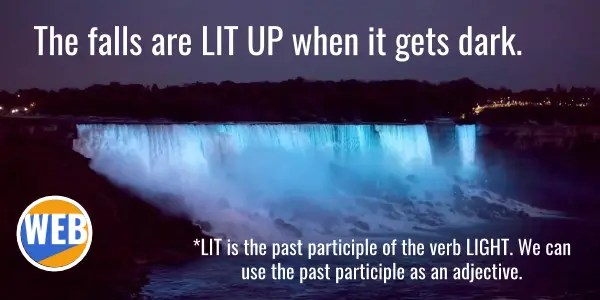
More past participle review @ my PASSIVE VOICE post HERE.
Audio B
The waterfalls are not the tallest in the world but they are very wide. The amount of water that travels over the falls is huge! During the highest water flow times, as much as 2,400 cubic meters (m3) of water are moving over the edge of the falls every second. All this moving water is used to spin turbines to make electricity.
A spinning turbine converts (changes) the energy of flowing water into mechanical energy. A generator converts this mechanical energy into electricity. There are several power plants that send this electricity to houses and businesses in Ontario, Canada, and New York, U.S.A.

I had fun in Niagara Falls, even though I was only there for 1 night.
Now you talk using this new English
Your turn!
What is a tourist attraction in your country?
Have you been there? Did you have fun? What can you do there?
What tourist attractions have you visited in other countries?
Where do you want to visit next?
Write a comment in the REPLY section below and use your new English!
Parts One and Two of my Canada trip Learn Natural English stories.
Canada Trip Pt. 1
Canada Trip Pt. 2
- Learn English the FUN way – Famous Quotes (10 Quotes explained)Learn English with famous quotes Learn English with these 10 famous quotes! Meaning, vocabulary and grammar explained. Best English quotes 1 -“The world is changed… Read more: Learn English the FUN way – Famous Quotes (10 Quotes explained)
- Y Suffix Words (Learn with 60 examples, Video, Free PDF)Want to make your English sound more natural? Let’s talk about the suffix ‘-y’! It’s a handy way to turn words into adjectives, like ‘sunny’ or ‘funny.’ We’ll show you how, with lots of easy examples. Plus, grab our free PDF for extra practice! Let’s make learning fun!
- Learn Common English Idioms with Stop (30 example sentences)Using common English Idioms is one of the best ways to sound like a native speaker. In this post, I’m going to take a closer… Read more: Learn Common English Idioms with Stop (30 example sentences)
- 34 Example Words with the Prefix Inter- (Free PDF Download)Prefixes are an important part of the English language. They are added to the beginning of words to change their meaning, create new words, and… Read more: 34 Example Words with the Prefix Inter- (Free PDF Download)
- Learn the difference between GET and TAKE fast! (80 examples + Video)GET and TAKE – What’s the difference? Some of my English students in Japan have had trouble with the verbs GET and TAKE. These verbs… Read more: Learn the difference between GET and TAKE fast! (80 examples + Video)


